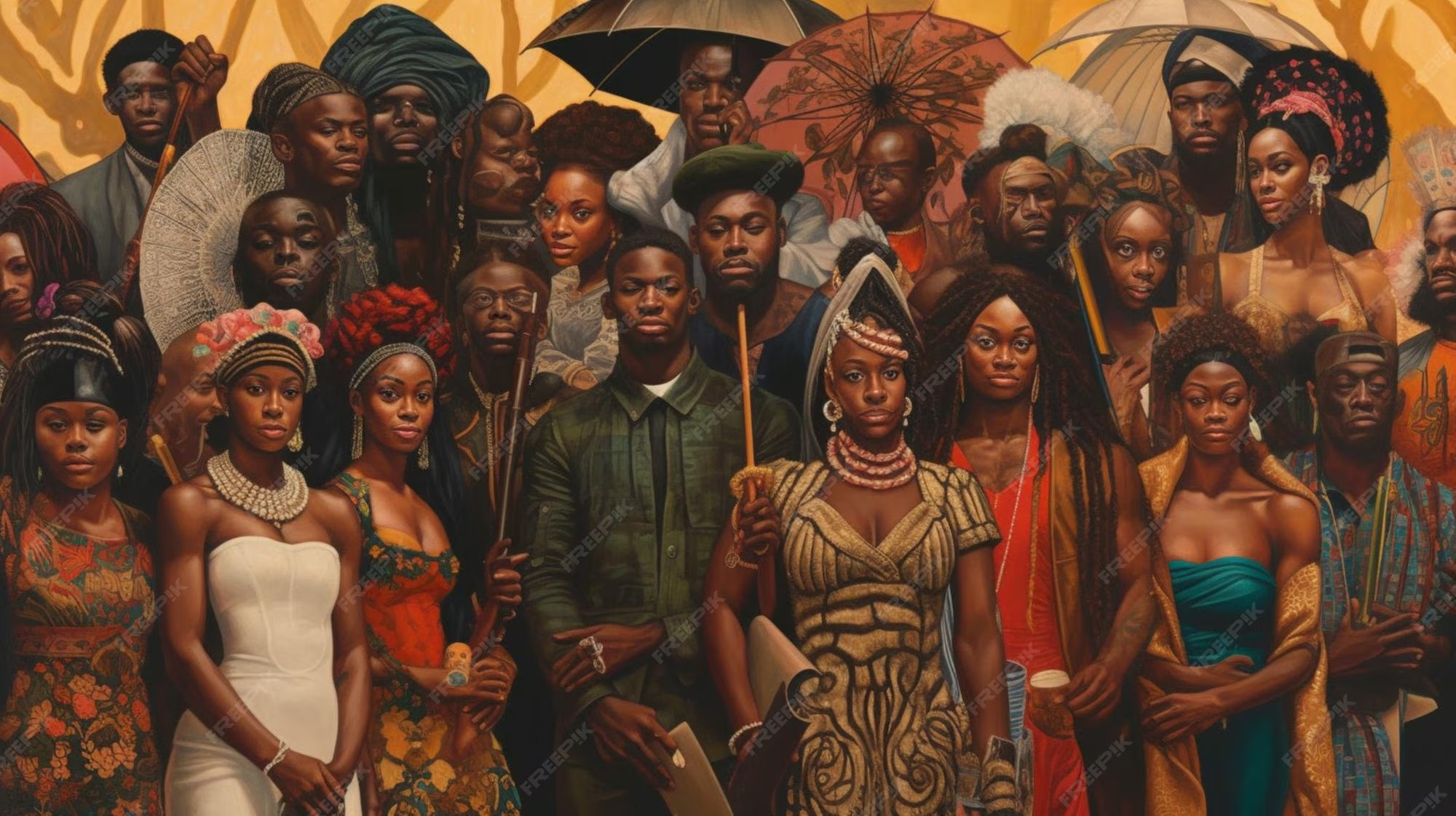
The “Cultural Divide” is a term used in Black Gay Literature to describe the tension or gap that exists between different cultural groups within the Black LGBTQ+ community. This divide can manifest in various ways, such as differences in language, values, social norms, or even aesthetic preferences. These distinctions often arise from unique historical and social contexts that shape the experiences and identities of individuals within the community. The cultural divide can also intersect with other forms of identity, including race, gender, and class, creating complex layers of diversity and sometimes leading to internal conflicts or misunderstandings. In literature, this divide can be explored through themes that highlight the struggles, negotiations, and dialogues between different cultural identities within the Black LGBTQ+ spectrum. Understanding and bridging this cultural divide is important for fostering inclusivity and solidarity within the community, as well as for enriching the broader cultural and literary landscape.
This divide in Black Gay Literature can be understood in the context of the complex historical position Black LGBTQ+ people have found themselves in throughout history. During the Harlem Renaissance in the 1920s, Black and African American culture formed a very visible, though mostly closeted, gay subculture. Black intellectuals such as Alain Locke, Countee Cullen and Wallace Thurman were writing work in which homosexuality was frequently coded, a common occurrence in the writing of Black gay and lesbian literature in later decades. The only work in the short-lived Harlem publication FIRE!! to directly describe bisexuality was Richard Bruce Nugent’s short story ‘Smoke, Lilies and Jade’. The motivation for this coding and concealment was a product of both general homophobia and specific anxieties about the potential impact of public homosexuality on the race’s struggle for rights and respectability. During the mid-twentieth century, Civil Rights Movement and the later Black Power movement’s largely hypermasculine and heteronormative positions were, in some part, developed in opposition to racist depictions of Black sexuality. James Baldwin, who was at the time one of very few well-known Black gay authors, was an important literary figure during this time. Baldwin’s novels Giovanni’s Room (1956) and Just Above My Head (1979) were milestones in the depiction of homosexuality, with the former being his first explicit depiction of homosexuality (with white characters) and the latter dealing more directly with the lives of Black gay men. The 1970s and 1980s were also key for the development of an explicitly intersectional politics with the formation of the Combahee River Collective, a group of Black lesbian feminists such as Audre Lorde and Barbara Smith. Their published statement and writing alongside other Black lesbian writers such as Cheryl Clarke and Pat Parker also helped lay the groundwork for Black lesbian literature which was able to focus more on the racism and homophobia they were facing. The 1980s were also an important time for Black gay men as the AIDS crisis disproportionately affected gay Black men but also led to a mobilisation of a new generation of writers and activists such as Essex Hemphill, Marlon Riggs, and Joseph Beam who published work that would not separate race and sexuality. Beam’s anthology In the Life (1986) and its posthumous successor Brother to Brother (1991) (edited by Hemphill after Beam’s death from an AIDS-related illness) would provide the foundations for Black gay male writing in later decades.
Societal expectations have, historically, applied pressure to Black Gay Literature from several directions at once. The church has often functioned as a central Black community institution both fighting racism and enforcing homophobic theology and practice. References to, and negotiations of, the church and other religious traditions run through Black gay writing from James Baldwin’s ambivalence and pain to the hardwon affirmations of faith in Danez Smith’s poetry collection Don’t Call Us Dead (2017). The emphasis in Black communities on ‘showing a united front’ against racism and outsiders has also been used to silence internal critique or dissent, including critiques around sexuality or gender. Black gay authors who critique homophobia and patriarchy in Black communities risk being accused of being race traitors or snitches or of giving ammunition to racists. In predominantly white LGBTQ+ literary circles and publications, the expectation often pushed on Black writers is to downplay or downscale the racial dimensions of their work to make it palatable to white audiences, which can be accompanied by accusations of ‘not being gay enough’ when Black writers foreground racial justice themes and commitments. Some Black gay writers have developed creative strategies in response to these cross-pressures. Some authors have taken what scholar Darieck Scott has called an ‘extravagant abjection’, that is, an embrace of, rather than a flight from, stigmatized positions and identities as a wellspring of radical critique and political possibility. In other work, speculative fiction and world-building become ways of responding to the perceived limits of the here and now, as in Rivers Solomon’s An Unkindness of Ghosts (2017). The publishing industry’s marketing categories and assumptions about audiences have also reinforced these cultural divides. Black gay literature has long been deemed to fit in highly specialized and niche book categories, with far smaller marketing budgets and more limited distribution outlets. Black gay books have seen success at the box office, but overall have suffered in terms of the attention, promotion, and bookstores shelf space they receive relative to more mainstream titles. There are also societal expectations in terms of acceptable or conventional narratives and literary modes. Black gay authors have long been expected either to produce coming out stories that center sexuality or racial uplift stories that play down sexuality and gender issues. Increasingly, new authors and new books refuse this choice in form and content. The internet and social media have also become alternative spaces for Black gay authors to build audiences independent of the conventional publishing world, but with different sets of normative expectations and new levels of visibility and risk. In many ways, the pressure from these directions has limited the range of Black gay literature; in other ways it has expanded it.
Intersectionality offers the most flexible and comprehensive way of thinking about cultural difference in Black Gay Literature. Intersectionality names a set of analytical tools that can be used to understand the simultaneous operation of multiple identity factors in the formation of specific and situated subject positions. The term ‘intersectionality’ was coined by legal scholar Kimberlé Crenshaw in a 1989 law review article. Before then, many Black LGBTQ+ writers were already expressing the insights that Crenshaw formalized through their literary work. Audre Lorde’s work and essays, especially ‘Age, Race, Class, and Sex: Women Redefining Difference’ (1980), was one of the most important early sources of intersectional analysis. Intersectionality is also useful for understanding Black Gay Literature because it shows why this work cannot simply be included in African American literature or LGBTQ+ literature. Instead, Black Gay Literature emerges from an intersection of experiences that fundamentally reshape and redefine both race and sexuality. These aesthetic qualities of Black Gay Literature include things like the distinctive forms and styles these texts employ. For instance, many Black gay texts use what the scholar Kara Keeling terms a ‘queer temporality’ in their non-linear conceptions of time. Black gay texts’ perspective also often shifts between various identity markers depending on the situation, which shows the contextual nature of intersectional identities. For more contemporary writers, intersectionality means expanding beyond the categories of race and sexuality. For instance, Janet Mock’s memoir Redefining Realness (2014) is centrally concerned with Blackness, transness, class insecurity, and survivorship. Brandon Taylor’s novel Real Life (2020) is about how class background can produce fissures and hierarchies even within Black gay graduate student communities. Intersectionality also allows for thinking about potential tensions within Black Gay Literature itself. As Black gay writers occupy different class locations, gender identities, able-bodied norms, or national origins, their individual perspectives and political investments can come into conflict. Intersectionality as a concept both refuses reductive generalizations about what a ‘Black gay experience’ might be while also allowing for thinking about specificity without losing sight of common structural locations. At the same time, intersectionality usefully shifts the focus away from identity categories per se and toward the power systems that create them. This shift in focus allows Black gay literature to push beyond the politics of representation toward more radical questions about racial and sexual categories themselves. Instead of simply adding Black gay figures to literary texts, an intersectional approach has the potential to fundamentally reorient those literary texts, aestheticizing new political horizons.
The challenges to the various efforts to bridge the gap in Black Gay Literature are serious, but not insurmountable. Institutional obstacles persist, from universities and their departments that segregate African American and queer studies, to booksellers forced to place Black gay books on shelves devoted to African American, LGBTQ+, or general literature, to publishers who (still) market books to readers based on categories that work poorly for intersectional literature (resulting in often less promotion of books that cannot be shoehorned into existing categories) to the market pressure to create ‘universal’ (read: white-accessible) narratives that still haunts writers seeking entry into ‘commercial’ literary success. In the Black community, homophobia—often in the service of religious and/or spiritual communities—remains a serious obstacle to Black gay literature reaching Black readers, while racism and a preference for white-authored works remains an obstacle for Black gay writers in LGBTQ+ literary circles. However, the various opportunities to bridge this gap are growing. Online and digital publishing provide a space for Black gay writers to reach readers without the traditional gatekeepers, while small presses dedicated to Black LGBTQ+ literature have published significant work (e.g., Redbone Press, BLF Press, among others) that larger presses may have deemed too niche. Book festivals and similar literary events that focus on Black LGBTQ+ writing (e.g., Fire & Ink) create a physical space for dialogue and community building that transcends the Black-gay divide. In education, Black gay literature is more often included in teaching and learning than was previously the case, bringing new generations of readers to these texts. The increased visibility of Black gay writers in the mainstream (from Roxane Gay to Saeed Jones, among others) creates more visibility and more paths for new writers to enter the literary conversation. Crossing genre boundaries can be a useful tool for reaching multiple audiences; Black gay writers working in genre fiction (especially science fiction, e.g. N.K. Jemisin; young adult literature, e.g. Kacen Callender; and mystery, e.g. S.A. Cosby) have attracted readers from across traditional divides. Anthologies and other projects that bring writers from different positions within the Black LGBTQ+ umbrella into a single multi-vocal space have highlighted the diversity within while building solidarity (examples include Cruesdes: Queer Black Romances, edited by Amy Heron, and Darlingonica: Black Girl Magic as Dark Fiction, edited by Michael Morris and Amanda Foxx). Most encouragingly, younger readers may well be both more accustomed to the intersection of multiple identities and less likely to cleave to the traditional categorizations that separate these works, providing an audience more ready to receive these books than was perhaps true a few decades ago. The key work, then, may be to find ways to support and sustain the infrastructure (publishing opportunities, critical and financial support, educational structures, etc.) that can support Black gay literature beyond the occasional breakthrough book or author.
The Black-gay divide presents itself quite differently in other cultural and geographic contexts, given the global diversity of colonial histories, racial formation, and sexual regulation. Black gay literature in the United States is uniquely inflected by that nation’s specific history of chattel slavery, Jim Crow segregation, and the racialized myth of Black hypersexuality that was used to justify both racial violence and white homoerotic desire for Black men. For this reason, many American Black gay writers more explicitly thematize or intervene in that national context; for example, Robert Jones Jr.’s novel ‘The Prophets’ (2021) centers on a same-sex relationship between two enslaved men on a plantation. Black gay literature in the United Kingdom is different, in turn, due to the particular history of British colonialism and post-colonial immigration to that nation, with writers like Bernardine Evaristo (‘Mr. Loverman’, 2013, about an older Caribbean-born man in London who comes to terms with his sexuality) engaging with specifically British forms of racism and homophobia. Caribbean literature constitutes another distinct tradition, with writers like Thomas Glave, Dionne Brand, and Marlon James writing in relation to the legacies of colonialism, including the anti-sodomy laws imposed by European colonial powers that persist in most Caribbean nations today; their writing often directly thematizes the pain of homophobic nationalism in the post-colonial moment. African literature has also begun to make important contributions by LGBTQ+ writers, despite the strict criminal and social penalties for homosexuality that persist in most African countries; for example, Chinelo Okparanta (Nigeria), whose novel ‘Under the Udala Trees’ (2015) follows a lesbian relationship during the Nigerian Civil War, has published most of her work from a diaspora position that provides greater freedom of expression. South African Black gay literature reflects that country’s distinct apartheid history and progressive post-apartheid constitution, with influential work ranging from Zanele Muholi’s visual documentation of Black lesbian lives to Neville Hoad’s queer archive-building. Overall, what a comparative perspective reveals is the specificity of these local contexts and the patterns of transnational connection between Black gay writers in different nations. Digital platforms have facilitated new forms of transnational exchange and influence across borders, while translation has made more works available across language communities. Anthologies like ‘Q&A: Queer in African Literature’ have helped create pan-African queer literary platforms. Despite these points of contact, there are also significant differences in how race, sexuality, and literary expression intersect and diverge across different contexts. The very categories of ‘Black’ and ‘gay’ themselves mean different things and have different histories in different places, which resists a universalizing definition of Black gay literature even as it also shows the global reach of both racial and sexual oppression.
Race, ethnicity, and sexuality in Black Gay Literature serve as central aspects of identity for characters and influence narrative structure, language, themes, and aesthetics. Racial identity can be presented not only in terms of skin color but also in terms of how characters navigate the world, how they understand themselves, and how they are perceived by others. It is often addressed directly in these texts, with characters exploring their racial identity and the process of becoming aware of their Blackness. Ethnicity also plays a significant role, as writers from various ethnic backgrounds within the Black diaspora draw on their specific cultural references, languages, and histories in their work. For writers of Caribbean descent such as Nicole Dennis-Benn, whose novel Patsy (2019) follows a Jamaican woman who leaves her daughter behind to seek economic opportunity and a lesbian relationship in the United States, national origin and immigration status can add further layers of complexity to the racial dynamics at play beyond a binary understanding of Black and white. Sexual orientation is another defining feature of Black gay literature, shaping the narrative and influencing characters’ relationships with family, community, and society at large. Characters often confront homophobia and heteronormativity, and their experiences are shaped by the specific challenges and stigma they face as LGBTQ+ individuals. Some texts explicitly challenge fixed sexual identity categories, depicting desire as fluid and contingent rather than fixed or innate. These complex identity factors manifest in formal innovations in Black gay texts. Code-switching, or the practice of alternating between languages or language varieties, is common, reflecting how characters move between different spaces with different expectations and potential dangers. Many texts use multiple languages or dialects, not as decorative or exotic elements, but as authentic representations of their characters’ multilingual experiences. Non-linear and fragmented narrative structures are often employed to reflect the disrupted temporality of lives spent in the margins, negotiating a hostile environment, or the experience of being between established categories. The convergence of these identity factors leads to what scholar José Esteban Muñoz described as ‘disidentification,’ a process of engaging with dominant cultural forms while simultaneously working against them, transforming them to represent one’s own marginalized experience. This dynamic allows Black gay writers to participate in both Black and LGBTQ+ literary traditions while reimagining these forms to account for intersectional identities. Race, ethnicity, and sexual orientation in Black Gay Literature are not fixed identity positions but generative forces that create distinct literary possibilities through their convergence.
In the field of Black Gay Literature, there is a clear cultural divide between the various communities. However, there is also a question of how one might use such divisions to their advantage in different literary and political contexts. This divide should not simply be something to overcome in our work with black gay writing. It should also be a tool that black gay writers and artists can use in their writing and artistic practices to generate literary and political value. The history of marginalization in more than one community can be transformed into a way of being marginalized in many communities at once as an empowering source for black gay writing practices and literary techniques. This is a way of speaking that does not yet have a form that adequately describes it, and it is a way of speaking that is aware of the pain of existing on a border. It is a position that, while giving rise to sharp political insights and literary creativity that may not be possible from other, more privileged points of view, is also always a struggle to define, express, and be seen. It is a place where the world’s cruelty is most raw, but it is also a place where the world’s transformative possibilities are most clearly seen. A commitment to Black Gay Literature in the future will require work on these issues of access in a structural sense while also respecting the agency of writers and artists to decide for themselves which communities they write for or which literary traditions they wish to be part of. It will require an internal openness to diversity within black gay literature itself in terms of different classed, gendered, national, or generational emphases and goals and, most crucially, an understanding that overcoming a cultural divide does not necessarily mean bridging it so much as it does making room for the differences that exist on either side of it. The cultural divide in Black Gay Literature has the potential to teach us more than just about the study of literature; it has the potential to teach us about living a more truthful and just life in a world full of many divides.